Explore this guide
Our guides combine current planning research with practical knowledge from arranging safaris, Kilimanjaro climbs and Zanzibar holidays.
Quick Answer
Ndutu is part of the wider Serengeti ecosystem, but most of the area commonly called Ndutu lies inside the Ngorongoro Conservation Area, immediately south of Serengeti National Park. The confusion arises because wildlife moves freely across this unfenced landscape, and many safari itineraries describe the entire calving region as the “Southern Serengeti.”
Is Ndutu in the Serengeti National Park?
Strictly speaking, most of Ndutu is not inside Serengeti National Park. Lake Ndutu, Lake Masek and many well-known Ndutu camps are located within the Ngorongoro Conservation Area, which is administered separately from Serengeti National Park.
However, Ndutu forms part of the same continuous wildlife ecosystem. There is no wildlife fence dividing the Ngorongoro Conservation Area from Serengeti National Park, so wildebeest, zebras, gazelles and predators move between the two protected areas according to rainfall, grass and water availability.
This leads to 3 different uses of the word “Serengeti”:
- Serengeti National Park – the officially protected national park administered by Tanzania National Parks.
- The Serengeti ecosystem – the much larger natural landscape encompassing the national park and surrounding conservation areas.
- Southern Serengeti – a safari term often used for the short-grass plains around Ndutu and the southeastern section of Serengeti National Park.
Therefore, saying that Ndutu is in the Serengeti ecosystem is accurate. Saying that every camp or game-drive area in Ndutu is inside Serengeti National Park is not.
Ndutu Location at a Glance
| Question | Direct answer |
|---|---|
| Country | Tanzania |
| General region | Northern Tanzania safari circuit |
| Main protected area | Mostly within the Ngorongoro Conservation Area |
| Wider ecosystem | Serengeti ecosystem |
| Nearby national park | Serengeti National Park |
| Important landmarks | Lake Ndutu and Lake Masek |
| Main safari season | Approximately December to March |
| Main wildlife attraction | Great Migration calving season |
| Nearest seasonal airstrip | Ndutu Airstrip |
| Common road access | Arusha or Moshi via Karatu and the Ngorongoro Conservation Area |
| Recommended stay | 3 nights for most calving-season safaris |
| Easy combinations | Ngorongoro Crater, Central Serengeti and Tarangire National Park |
Where Exactly Is Ndutu Located?
Ndutu lies on the borderland between the Ngorongoro Conservation Area and the southern edge of Serengeti National Park. It is northwest of Ngorongoro Crater and southeast of Seronera in Central Serengeti.
The core safari area includes:
- Lake Ndutu
- Lake Masek
- Ndutu woodlands
- Surrounding short-grass plains
- Marshes and seasonal water sources
- The plains extending toward Kusini and the southeastern Serengeti
Lake Ndutu and Lake Masek are shallow, seasonally influenced lakes surrounded by woodland and open plains. These varied habitats support resident wildlife throughout the year, although Ndutu receives its greatest concentration of animals during the rainy-season migration.
The name “Ndutu” does not describe one precisely fenced tourism zone. Guides may use it to refer to the lakes, woodlands, nearby plains and the broader calving area on both sides of the conservation boundary.
Why Is Ndutu Called the Southern Serengeti?
Ndutu is commonly marketed as the Southern Serengeti because it shares the landscape, wildlife and migration cycle associated with the Serengeti.
The term is useful for explaining the safari experience, but it can hide an important administrative distinction. The plains used by the migrating herds extend across:
- The western and northern parts of the Ngorongoro Conservation Area
- The southeastern section of Serengeti National Park
- The open plains surrounding Ndutu, Lake Masek and nearby seasonal camps
Animals do not recognize administrative boundaries. Your safari vehicle, however, must follow the permits, entry rules and game-drive regulations of the protected area in which it is operating.
A properly designed itinerary should therefore identify where each camp is located and which conservation-area or national-park fees apply.
Ndutu, Southern Serengeti and Central Serengeti Compared
| Feature | Ndutu area | Southern Serengeti National Park | Central Serengeti |
|---|---|---|---|
| Administration | Mainly Ngorongoro Conservation Area | Tanzania National Parks | Tanzania National Parks |
| Landscape | Lakes, woodland and short-grass plains | Predominantly open short-grass plains | Savannah, woodland, river valleys and kopjes |
| Main seasonal attraction | Calving herds and predators | Migratory herds on the southern plains | Strong resident wildlife throughout the year |
| Most suitable months | December–March, depending on rainfall | December–March, depending on herd movements | Year-round |
| Typical stay | 2–4 nights | Often explored from a seasonal camp | 2–3 nights |
| Access | Road or seasonal flight | Road or seasonal air access | Road or flights through Seronera |
| Wildlife-driving flexibility | Regulations vary by management zone | National-park rules apply | National-park rules apply |
| Best suited to | Calving safaris and photography | Migration-focused safaris | General wildlife and longer northern-circuit trips |
Does the Boundary Matter to Safari Travellers?
Yes. Although the landscape is continuous, the official boundary can affect your itinerary, permits, costs, game-drive rules and choice of accommodation.
Park and conservation fees
The Ngorongoro Conservation Area and Serengeti National Park have separate administration and fee structures. A route that crosses from Ndutu into Serengeti National Park may require fees for both protected areas.
Government fees can change, and the amount payable depends on factors including:
- Nationality or residency
- Age of each traveller
- Number of nights
- Camp location
- Vehicle movements
- Whether the itinerary enters Serengeti National Park
- Whether it includes Ngorongoro Crater
Your quotation should clearly state which park, conservation and concession fees are included. Current fees must be verified when the itinerary is priced.
Accommodation location
Two camps advertised as being in “Ndutu” may fall under different administration or operate in different parts of the calving area.
Before choosing a camp, confirm:
- Whether it is in the Ngorongoro Conservation Area or Serengeti National Park
- Whether it is permanent, seasonal or mobile
- Its approximate distance from current wildlife concentrations
- Which fees apply
- Whether an additional park entry is required for the planned game drives
For a detailed comparison, read Ndutu Camps Inside vs Outside the Ngorongoro Conservation Area.
Game-drive regulations
Rules can differ between Serengeti National Park and the Ngorongoro Conservation Area. Your guide must follow the regulations applying to the exact location, including approved tracks, operating hours and any restrictions on off-road driving.
Do not assume that off-road driving is automatically permitted throughout Ndutu. Conditions and official instructions can change, and responsible guides avoid damaging wet grasslands or disturbing wildlife.
What Is the Serengeti Ecosystem?
The Serengeti ecosystem is larger than Serengeti National Park. It is a connected landscape of grassland, woodland and protected areas in northern Tanzania and southwestern Kenya.
Its Tanzanian component includes Serengeti National Park, parts of the Ngorongoro Conservation Area and surrounding protected landscapes. This connected habitat allows migratory wildlife to follow seasonal rain and fresh grazing.
UNESCO identifies the Serengeti as the setting for the world’s largest remaining largely unaltered animal migration, involving more than 1 million wildebeest and hundreds of thousands of other herbivores.
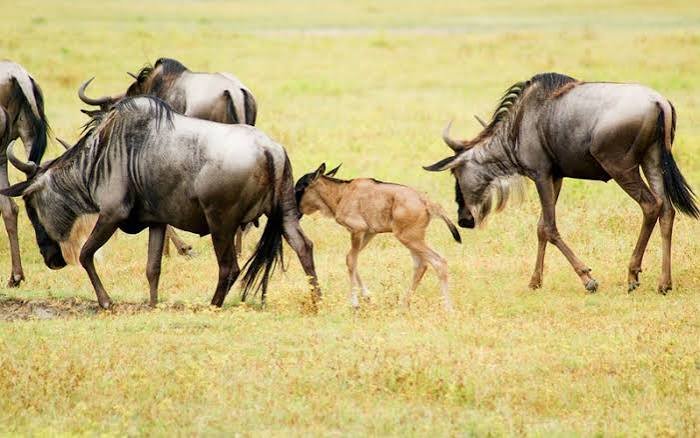
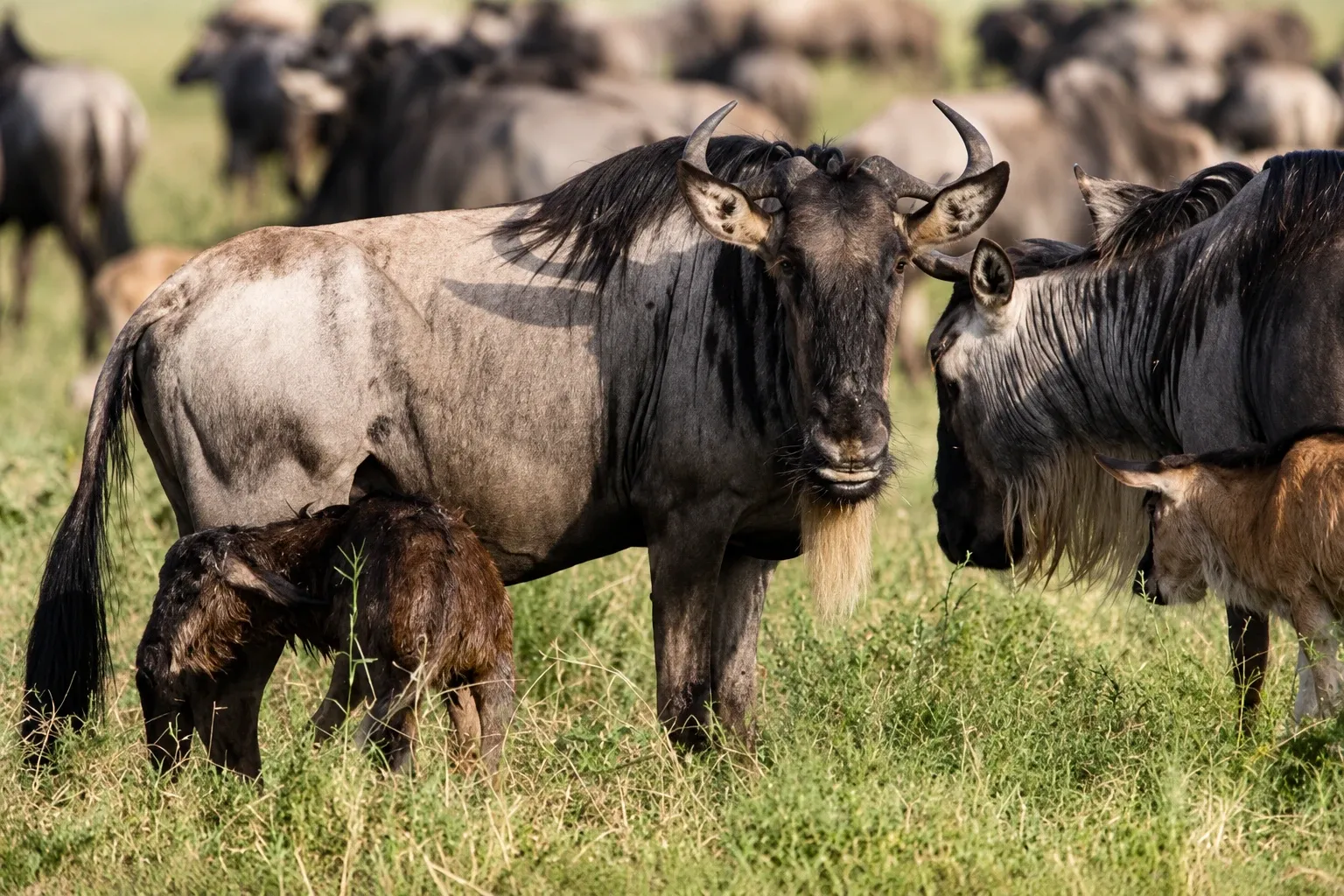
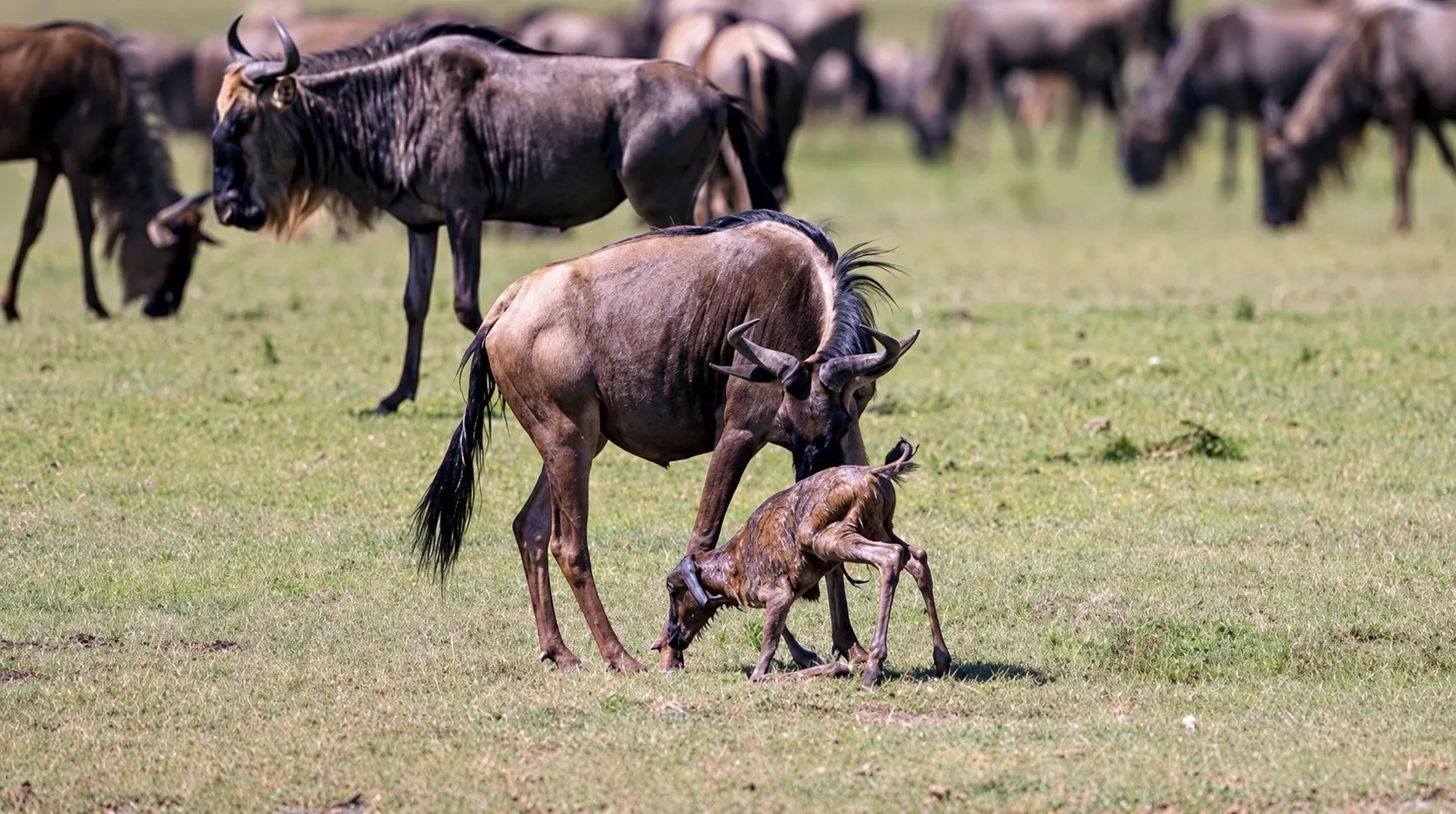
Ndutu plays a critical role because its short-grass plains provide nutritious grazing during the wet season and support the calving stage of the Great Migration.
Why Do the Wildebeest Move to Ndutu?
The migration is driven mainly by rainfall, water availability and fresh grazing—not by fixed calendar dates.
After seasonal rains reach the southern plains, new grass begins to grow. The volcanic soils associated with the wider Ngorongoro landscape help produce short, mineral-rich grazing suitable for pregnant and nursing wildebeest.
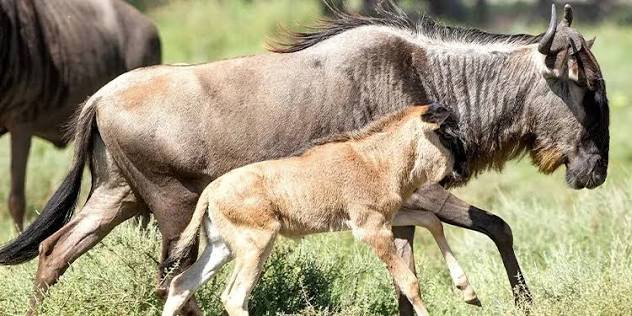
The herds commonly spread across Ndutu and the southern plains from approximately December through March. Calving is generally associated most strongly with late January and February, but the exact location and timing vary each year.
Travellers should understand that:
- The herds may be widely dispersed rather than gathered in one place.
- Early or delayed rains can change their movements.
- Some animals may be inside the Ngorongoro Conservation Area while others are across the boundary in Serengeti National Park.
- No operator can guarantee a particular sighting or herd location.
For a broader seasonal explanation, see the Ndutu Calving Season Safari Guide.
Is Ndutu Only Worth Visiting During Calving Season?
No. Ndutu supports resident wildlife outside the main migration months, but the safari experience changes considerably.
| Period | What travellers may expect |
|---|---|
| December | Rains may draw migrating herds toward the southern plains; timing varies |
| January | Herds often spread across Ndutu and the surrounding short-grass plains |
| February | Usually the principal calving period, with strong predator activity |
| March | Herds may remain in the south or begin shifting west and northwest |
| April–May | Green landscapes, fewer visitors and unpredictable herd locations |
| June–October | Most migration herds are normally elsewhere; resident wildlife remains |
| November | Short rains may begin influencing the southward return |
These are general seasonal patterns, not fixed promises. Rain can move wildlife earlier, later or into a different section of the ecosystem.
Travellers primarily interested in the calving herds should normally prioritize January to early March. Those interested in quieter landscapes, birdlife and resident predators may also appreciate the green season outside the peak weeks.
What Wildlife Can You See in Ndutu?
During the calving season, the Ndutu area can support large numbers of:
- Blue wildebeest
- Plains zebras
- Thomson’s gazelles
- Grant’s gazelles
- Elands
- Lions
- Cheetahs
- Spotted hyenas
- Black-backed and golden jackals
- Servals
- Vultures and other scavenging birds
The mixture of woodland, lake margins and open plains creates opportunities to search for both migratory and resident species.
Predator activity is an important part of the Ndutu experience because young and vulnerable animals attract carnivores. However, hunts and births are natural events that cannot be scheduled or guaranteed.
How Do You Reach Ndutu?
Ndutu can be reached by road or light aircraft.
Driving from Arusha
A road journey usually follows the route from Arusha through Mto wa Mbu and Karatu before entering the Ngorongoro Conservation Area and continuing toward Ndutu.
The drive normally occupies most of the day when entrance formalities, road conditions, stops and wildlife viewing are included. A realistic planning estimate is approximately 6–8 hours, although the duration varies.
Many itineraries break the journey with a night in Karatu or combine the transfer with Ngorongoro Crater.
Driving from Moshi
From Moshi, travellers generally pass through Arusha before following the northern safari circuit toward Karatu and Ndutu. The journey is longer than from Arusha and usually requires a full travel day.
A planning estimate is approximately 7–9 hours, depending on the starting hotel, stops, gate procedures, weather and road conditions. For a more comfortable schedule, an overnight stay in Arusha or Karatu may be recommended.
Flying to Ndutu
Seasonal scheduled and charter flights may operate to Ndutu Airstrip during the calving period. Flights can reduce road time and are particularly useful for:
- Short safari itineraries
- Families travelling with children
- Travellers connecting from Zanzibar
- Guests who prefer to avoid long, rough-road transfers
- Fly-in and fly-out calving safaris
Flight schedules, operating dates and luggage limits depend on the airline and aircraft. They must be checked for the traveller’s exact dates.
Travelling from Central Serengeti
The journey between Central Serengeti and Ndutu is commonly completed as a game-drive transfer. The exact duration depends on wildlife stops, road conditions, camp locations and the route permitted on that day.
Allowing most of the day is usually more practical than treating it as a simple point-to-point transfer.
How Many Nights Should You Spend in Ndutu?
For a calving-season safari, 3 nights in Ndutu is the strongest general recommendation. This provides 2 full days for exploring different sections of the plains and responding to recent wildlife information.
| Length of stay | Suitable for | Main limitation |
|---|---|---|
| 1 night | Travellers passing between Ngorongoro and Serengeti | Very limited time and vulnerable to weather or distant herds |
| 2 nights | Short itineraries with 1 full game-drive day | Reasonable, but still restricted |
| 3 nights | Most first-time calving safari travellers | Good balance of time, cost and flexibility |
| 4 nights | Photographers and migration-focused travellers | Higher accommodation and conservation costs |
A 2-night stay may work if the itinerary is short and the camp is well positioned. However, 3–4 nights provide more flexibility when the herds are dispersed or rain affects road conditions.
Should You Combine Ndutu With Central Serengeti?
Yes, particularly when the itinerary has at least 6–7 safari days.
Ndutu and Central Serengeti provide complementary experiences:
- Ndutu concentrates on the seasonal migration, calving grounds and open-plains predator activity.
- Central Serengeti offers varied habitats and strong resident wildlife throughout the year.
- Combining them reduces dependence on finding all priority wildlife in one location.
- The transfer can itself be used as a game drive.
A practical calving-season route may include:
- Tarangire National Park
- Karatu or Ngorongoro Conservation Area
- Ngorongoro Crater
- Ndutu for 3 nights
- Central Serengeti for 2 nights
- Flight from Seronera to Arusha or Zanzibar
Travellers with only 3–4 safari days may be better served by concentrating on Ndutu and Ngorongoro rather than covering too many destinations.
Is Ndutu Better Than Central Serengeti?
Neither area is universally better. The correct choice depends on the month and the traveller’s priorities.
Choose Ndutu when:
- Your main interest is the calving season.
- You are travelling between January and early March.
- You want open-plains wildlife photography.
- You can dedicate at least 2–3 nights to following the herds.
Choose Central Serengeti when:
- You are travelling outside the main southern migration season.
- You want reliable year-round general wildlife viewing.
- You have limited time and prefer a central base.
- You want to combine several Serengeti regions.
Combine both when:
- You have 6 or more safari days.
- You want both migration-focused and general wildlife viewing.
- Your budget allows for the additional accommodation, fees and transfer.
Common Planning Mistakes
Assuming all Ndutu camps are in Serengeti National Park
Many are within the Ngorongoro Conservation Area. Confirm the precise location and applicable fees before booking.
Spending only 1 night in Ndutu
One night provides little flexibility if the herds are distant, roads are wet or the arrival takes longer than expected.
Treating wildlife movements as a fixed calendar
The migration follows rain and grazing. February is historically associated with calving, but no date guarantees a particular herd location or event.
Booking accommodation without checking its position
A camp described as “Southern Serengeti” may be far from where the herds are expected during your dates. Location should be evaluated together with comfort and price.
Covering too many parks
A rushed itinerary can reduce useful game-drive time. For a short February safari, spending longer in Ndutu may be more rewarding than adding several distant parks.
Ignoring separate protected-area fees
Crossing between the Ngorongoro Conservation Area and Serengeti National Park can affect the quotation. Ask for an itinerary with all mandatory fees clearly included.
Responsible Travel in the Ndutu Plains
The calving season attracts many visitors, and responsible guiding is important for protecting the animals and grasslands.
Travellers and guides should:
- Maintain a respectful distance from births, hunts and resting predators.
- Avoid surrounding animals with multiple vehicles.
- Never pressure a guide to break protected-area regulations.
- Remain quiet near stressed or vulnerable animals.
- Keep all waste inside the safari vehicle.
- Avoid asking drivers to damage vegetation for a closer photograph.
- Choose legal camps that follow conservation and waste-management requirements.
- Respect local communities and ask before photographing people.
Wildlife welfare should take priority over obtaining a close photograph.
Who Is an Ndutu Safari Best Suited To?
Ndutu is particularly suitable for:
- Travellers whose main interest is the Great Migration calving season
- Wildlife photographers
- Couples seeking a private safari
- Families comfortable with longer game drives
- Repeat safari travellers interested in animal behaviour
- Visitors combining Ngorongoro Crater and Serengeti National Park
It may be less suitable for travellers who:
- Are visiting when the migration is far from the southern plains
- Expect guaranteed births or hunts
- Dislike rough or muddy roads
- Have only 1 day available
- Want to see every Big Five species in a single destination
A balanced itinerary can pair Ndutu’s seasonal wildlife with the resident game of Central Serengeti and the concentrated wildlife of Ngorongoro Crater.
KiliPori Expert Recommendation
For a safari between late January and early March, plan 3 nights in Ndutu rather than using the area as a quick transit stop. This gives your private guide time to follow recent reports and explore both the open plains and woodland habitats.
If you have 6–8 safari days, combine Ndutu with 2 nights in Central Serengeti and a visit to Ngorongoro Crater. Tarangire can be added when the itinerary and budget permit, but it should not reduce Ndutu below 2 nights when calving is the main purpose of the trip.
Ask for the exact location of each proposed camp. The words “Ndutu” and “Southern Serengeti” are sometimes used broadly, while the camp’s actual position affects driving time, park fees and access to different wildlife areas.
Frequently Asked Questions
Is Lake Ndutu inside Serengeti National Park?
No. Lake Ndutu is within the Ngorongoro Conservation Area, close to the boundary with Serengeti National Park. It forms part of the wider Serengeti ecosystem and southern migration landscape.
Is Ndutu the same as the Southern Serengeti?
Not exactly. Ndutu is a specific area centred around Lake Ndutu, Lake Masek, nearby woodland and plains. “Southern Serengeti” is a broader geographical and safari term that may include Ndutu and the southeastern plains inside Serengeti National Park.
Can animals move between Ndutu and Serengeti National Park?
Yes. The landscape is unfenced, allowing wildebeest, zebras, predators and other wildlife to move naturally between the Ngorongoro Conservation Area and Serengeti National Park.
Do I need separate fees for Ndutu and Serengeti?
Potentially, yes. Ndutu and Serengeti National Park are administered separately. If an itinerary enters both protected areas, separate government and accommodation-related fees may apply. The final calculation depends on the route and camp locations.
What is the best month for an Ndutu safari?
February is generally the most requested month because it falls within the principal wildebeest calving period. January and March can also offer excellent wildlife viewing, but rainfall determines the exact location of the herds.
How many days do I need in Ndutu?
Allow 3 nights if the calving season is your main interest. Two nights can work for a shorter itinerary, while photographers and wildlife-focused travellers may benefit from 4 nights.
Can I fly directly to Ndutu?
Seasonal light-aircraft flights may operate to Ndutu Airstrip during the calving season. Availability, schedules and luggage restrictions must be checked for your exact travel dates.
Can I visit Ndutu and Ngorongoro Crater in the same itinerary?
Yes. Ndutu and Ngorongoro Crater are commonly combined because both are within the wider Ngorongoro Conservation Area. They offer different experiences: seasonal migration viewing on the Ndutu plains and concentrated wildlife inside the crater.
Is Ndutu suitable for children?
Yes, provided the itinerary is planned with manageable driving hours, suitable accommodation and regular breaks. Fly-in access or an overnight stop in Karatu can help reduce long road journeys for younger children.
Are wildlife sightings guaranteed in Ndutu?
No. Ndutu is a natural, unfenced wildlife area. Rainfall, grazing conditions and animal behaviour influence where the herds and predators will be found. A knowledgeable private guide improves flexibility but cannot guarantee specific sightings.
Plan Your Trip With KiliPori Safaris
KiliPori Safaris can design a private Ndutu calving-season safari around your dates, group size, preferred accommodation and budget. Your itinerary can combine Ndutu with Ngorongoro Crater, Central Serengeti, Tarangire National Park or a flight to Zanzibar.
Ask us to compare road and fly-in options, explain the location of proposed camps and prepare an accurate quotation that includes the required conservation and park fees.
WhatsApp: +255 755 287 311
Final Recommendation
Ndutu is not entirely inside Serengeti National Park, but it is an essential part of the wider Serengeti ecosystem. Most of its best-known lakes, camps and game-drive areas lie within the Ngorongoro Conservation Area, beside the park’s southeastern boundary.
When asking, “Is Ndutu in the Serengeti?”, the practical answer is that it belongs to the Serengeti’s natural wildlife landscape but is mostly under different administration. This distinction matters when selecting camps, calculating fees and planning game-drive routes. For a January–March safari, stay about 3 nights in Ndutu and consider combining it with Central Serengeti and Ngorongoro Crater for a more varied Tanzania wildlife experience.
Sources and Fact-Checking
- Ngorongoro Conservation Area Authority – Ndutu Plains
- Tanzania National Parks – Serengeti National Park
- UNESCO World Heritage Centre – Serengeti National Park
- UNESCO World Heritage Centre – Ngorongoro Conservation Area
- Airline schedules, baggage limits, protected-area fees and operational regulations require confirmation for the traveller’s exact dates.

KiliPori Safaris Travel Team
A local Tanzania team helping travellers plan wildlife safaris, Kilimanjaro climbs and Zanzibar holidays with clear routing and direct destination support.
Published September 17, 2026. Travel conditions, fees and schedules can change; confirm time-sensitive details before departure.