Explore this guide
Our guides combine current planning research with practical knowledge from arranging safaris, Kilimanjaro climbs and Zanzibar holidays.
Overview
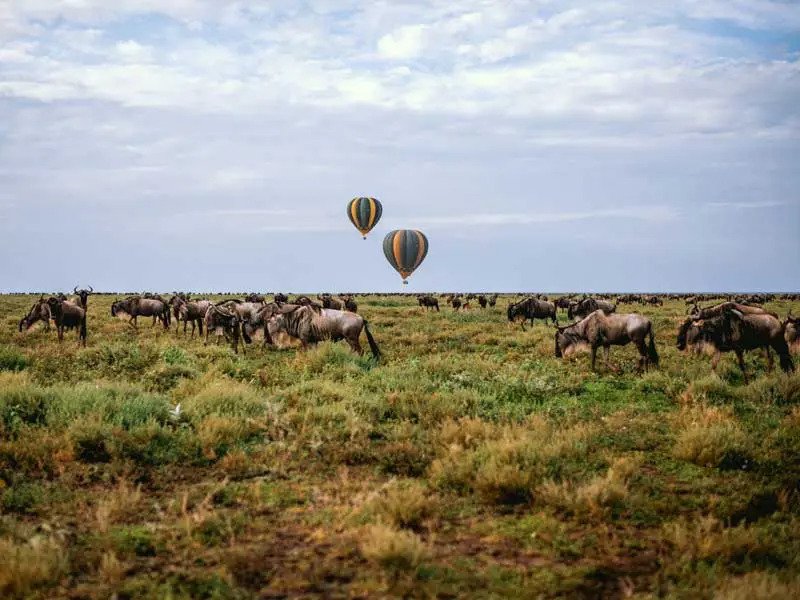
An Ndutu hot-air balloon safari provides a sunrise view over the Southern Serengeti ecosystem during the wildebeest calving season, generally between December and March. The complete activity usually includes an early camp pickup, safety briefing, approximately 50–70 minutes in the air, landing ceremony and bush breakfast. Wildlife sightings depend on the balloon’s route, wind direction and the herds’ location and cannot be guaranteed.
What Is an Ndutu Hot-Air Balloon Safari?
An Ndutu hot-air balloon safari is an early-morning flight over the plains, woodland and seasonal wildlife areas of the Ndutu region.
Unlike a game drive, the balloon does not follow roads or stop beside individual animals. It moves according to wind speed and direction, giving passengers a wider view of the landscape.
During the calving season, the flight may provide aerial views of:
- Wildebeest and zebra herds
- Newborn calves
- Animal tracks across the plains
- Gazelle herds
- Giraffes and elephants
- Lions, hyenas or other predators
- Lake Ndutu or Lake Masek, depending on the route
- Acacia woodland
- Seasonal pools and wetlands
- Sunrise across the Southern Serengeti
The actual route cannot be predetermined. The pilot selects a safe launch site, but the wind determines the flight path and landing area.
When Do Balloon Safaris Operate in Ndutu?
Ndutu balloon operations normally follow the southern stage of the Great Migration, commonly from approximately December to March.
The precise opening and closing dates vary according to:
- Operator schedules
- Protected-area authorization
- Seasonal camp location
- Weather
- Ground conditions
- Passenger demand
- Wildlife movement
Some balloon operators relocate their equipment and crews to other parts of the Serengeti when the migration moves north.
[Current verification required: Confirm the selected operator’s exact Ndutu operating dates for the intended travel season.]
Is February the Best Month for an Ndutu Balloon Safari?
February is generally the strongest month for combining a balloon flight with the wildebeest calving season. Large herds and young calves are often distributed across the short-grass plains.
However, February does not guarantee that the balloon will fly directly over the largest herd concentration. The balloon follows the wind rather than the wildlife.
| Period | What to expect |
|---|---|
| December | Herds may be arriving; exact location depends on rainfall |
| January | Green plains, pregnant wildebeest and increasing births |
| February | Main calving period and high seasonal demand |
| March | Calves are stronger and herds may begin moving |
| April | Most seasonal balloon operations have ended or relocated |
January may provide greener landscapes, while March can offer dramatic clouds and active herd movement. Rainfall can shift wildlife distribution within any month.
What Happens on the Morning of the Balloon Safari?
The full experience generally lasts several hours even though the flight itself is usually around 1 hour.
1. Early camp pickup
Passengers are collected from their lodge or tented camp before sunrise. Pickup time depends on the distance between the camp and launch site.
The transfer may begin between approximately 4:30 and 5:30 AM, but the confirmed time is provided the previous evening.
2. Transfer to the launch site
The drive takes place in darkness or early dawn. Wildlife may be encountered along the route, but this transfer should not be treated as a formal night game drive.
3. Safety briefing
The pilot explains:
- How passengers enter the basket
- The correct take-off position
- The required landing position
- When photography is permitted
- What to do during a firm or tipped landing
- The importance of following crew instructions
Passengers must pay close attention even if they have flown in a balloon before.
4. Balloon inflation
The balloon is laid out and filled first with cool air and then heated. Passengers usually watch from a safe position until instructed to enter the basket.
5. Take-off and flight
Flights normally begin close to sunrise when air conditions are generally cooler and more stable.
The pilot may alternate between:
- Low-level flight over suitable open areas
- Higher altitude for broader landscape views
- Different elevations to find suitable wind directions
6. Landing
The ground crew follows the balloon by vehicle. The pilot selects a suitable landing area based on terrain, wind and nearby wildlife.
Passengers must remain in the instructed landing position until the pilot confirms that it is safe to move.
7. Bush breakfast
After landing, passengers are usually transferred to a prepared breakfast location. The experience commonly ends with a full bush breakfast before passengers rejoin their guide.
Exact meal inclusions vary by operator.
How Long Is the Balloon Flight?
The flight generally lasts approximately 50–70 minutes, although it may be shorter or longer depending on:
- Wind conditions
- Availability of safe landing areas
- Wildlife on the ground
- Airspace considerations
- Pilot safety decisions
- Terrain
The entire activity—including transfers, briefing, flight, recovery and breakfast—can occupy much of the morning.
Travellers should avoid scheduling a time-sensitive flight or long road transfer immediately afterward.
How Much Does an Ndutu Hot-Air Balloon Safari Cost?
A realistic planning estimate is approximately $599 per person, although Ndutu rates can change by season, operator and included services.
The price generally covers:
| Usually included | Confirm before booking |
|---|---|
| Transfer from selected Ndutu camps | Whether your specific camp is within the pickup zone |
| Balloon flight | Expected flight duration |
| Licensed pilot and ground crew | Operator licensing and insurance |
| Safety briefing | Passenger restrictions |
| Landing transfer | Return arrangements after breakfast |
| Bush breakfast | Dietary requirements and drinks |
| Applicable balloon activity charges | Any additional protected-area charges |
The price may exclude:
- Accommodation
- Main safari package
- Park or conservation fees not already included
- Transport from camps outside the pickup area
- Tips
- Personal expenses
- Travel insurance
- Private basket arrangements
- Special celebration services
[Current verification required: Confirm the exact operator rate, taxes, pickup coverage and cancellation terms before quoting.]
Is the Ndutu Balloon Safari Worth the Cost?
It is worth considering if the traveller values landscape, scale and sunrise views rather than close wildlife encounters.
It may be worth it if you want:
- Aerial views of the Southern Serengeti ecosystem
- A special birthday, anniversary or honeymoon activity
- A different perspective from a game drive
- Sunrise photography
- A quiet, engine-free period above the plains
- A professionally operated aviation activity
- A bush breakfast after landing
It may not be the best use of the budget if:
- Close wildlife photography is your main priority
- You expect the balloon to follow the largest herds
- You are uncomfortable with heights
- You cannot adopt the required landing position
- You have a relevant health or mobility condition
- Your safari budget is already stretched
- You have only 1 full morning available in Ndutu
- A weather cancellation would significantly disrupt your plans
Travellers deciding between an extra night in Ndutu and a balloon flight should usually prioritize the additional night if the primary goal is wildlife viewing.
What Wildlife Can You See From the Balloon?
Possible sightings include:
- Wildebeest
- Zebras
- Thomson’s gazelles
- Grant’s gazelles
- Giraffes
- Elephants
- Buffalo
- Hyenas
- Jackals
- Lions
- Cheetahs
- Ostriches
- Flamingos or waterbirds when conditions are suitable
Large herds and tall animals are generally easier to identify from the air than small predators.
A lion or cheetah can be difficult to see against the ground, especially when the balloon is travelling at a higher altitude. The pilot may point out animals, but passengers should not expect the close identification possible from a 4×4 vehicle.
For a detailed overview of the area’s animals, see our guide to Southern Serengeti calving season wildlife and predators.
Will the Balloon Fly Over the Wildebeest Herds?
It may, but this cannot be guaranteed.
The balloon’s direction is determined by wind at different altitudes. The pilot can control ascent and descent and may use different wind layers, but a hot-air balloon cannot be steered like an aircraft.
The herd’s location can also change overnight according to:
- Fresh grazing
- Water
- Recent rain
- Predator pressure
- Disturbance
- General migration movement
A responsible operator will never promise that a flight will pass directly over the main herds.
Can You See a Wildebeest Birth From the Balloon?
It is highly unlikely. Although many calves may be born across the wider plains, an individual birth is difficult to identify from the air.
The balloon experience is better for observing:
- The scale of the herds
- Group movement
- Landscape patterns
- Animal trails
- The relationship between plains, lakes and woodland
- Sunrise and changing light
Travellers who want to observe detailed behaviour should rely on private ground-based game drives.
Balloon Safari vs Game Drive
A balloon flight complements a game drive; it does not replace one.
| Experience | Balloon safari | Private game drive |
|---|---|---|
| Perspective | Aerial and wide | Ground-level and detailed |
| Route control | Determined mainly by wind | Guide selects permitted roads and areas |
| Ability to stop | No | Yes |
| Close wildlife viewing | Limited | Better |
| Duration | About 1 hour in the air | Several hours or full day |
| Sunrise views | Excellent potential | Excellent from selected locations |
| Photography | Landscapes and herd patterns | Portraits, action and behaviour |
| Wildlife tracking | Limited | Guide can respond to current reports |
| Cost | High optional supplement | Normally part of the safari package |
| Weather dependence | Very high | Lower, although roads may be affected |
The strongest itinerary uses the balloon as an optional morning activity and continues with a private game drive afterward.
How Does the Balloon Fit Into a Safari Day?
After breakfast, passengers normally rejoin their private guide and continue with the planned safari.
A suitable schedule may include:
- Early pickup from camp
- Sunrise balloon flight
- Bush breakfast
- Rejoin the private driver-guide
- Late-morning game drive
- Picnic lunch or return to camp
- Afternoon game drive
The balloon morning can be tiring because of the early start. Travellers may choose a slower afternoon, particularly families or guests who arrived late the previous evening.
Your driver-guide and balloon operator must coordinate the collection point after breakfast.
Where Should You Stay for the Balloon Safari?
Choose accommodation within the operator’s approved pickup area. A camp described as “Ndutu” may still be too far from a particular launch site.
Before confirming accommodation, ask:
- Does the operator collect from this camp?
- What time will pickup take place?
- How long is the transfer to the launch site?
- Where will passengers meet their guide afterward?
- Will the lodge prepare early tea or coffee?
- Can breakfast at the lodge be skipped or credited?
- What happens if the flight is cancelled?
Well-positioned properties around Lake Ndutu, Lake Masek and the surrounding plains are commonly used for calving-season safaris. Review our guide to the best camps and lodges in Ndutu for the calving season.
Who Can Join a Balloon Safari?
Eligibility rules vary between operators, but passengers normally need to:
- Be above the operator’s minimum age
- Be tall enough to see safely over the basket
- Climb into and out of the basket
- Stand for approximately 1 hour
- Bend the knees and hold the landing position
- Understand and follow the pilot’s instructions
- Travel safely in the recovery vehicle
- Disclose relevant health conditions
- Accept the possibility of a firm landing
The operator has the final authority to accept or refuse a passenger on safety grounds.
What Is the Minimum Age?
The minimum age differs between operators. Some accept children from approximately 5–7 years, while others apply a higher minimum or use height and mobility requirements.
A child must be able to:
- See over the basket edge
- Follow the safety briefing
- Remain supervised
- Stand for the flight
- Adopt the landing position
- Cope with the burner noise and early start
Young children should not be booked until the operator confirms eligibility in writing.
[Current verification required: Confirm the child’s age, height and the selected operator’s current minimum-age policy.]
Are There Weight Restrictions?
Balloon operators need every passenger’s approximate weight for flight planning. This affects:
- Basket allocation
- Aircraft loading
- Fuel planning
- Passenger balance
- Safe operating limits
A surcharge or special arrangement may apply above a stated weight. Policies vary between operators, and passengers should provide accurate information when booking.
Weight information is collected for operational safety and should not be intentionally understated.
Who Should Not Take a Balloon Safari?
Operator medical rules vary, but ballooning is generally unsuitable for:
- Pregnant travellers
- People with significant mobility limitations
- Travellers unable to stand throughout the flight
- People unable to bend the knees for landing
- Travellers with recent surgery
- People with serious back or neck conditions
- Travellers with brittle bones
- Some heart or cardiovascular conditions
- Anyone under the influence of alcohol or drugs
Having a health condition does not always mean automatic exclusion, but it must be declared. The operator may require medical advice or decline participation.
Passengers should consult their doctor when personal health may affect safe participation.
Is a Balloon Safari Safe?
Hot-air ballooning is an aviation activity and should be operated by a licensed company using qualified pilots, maintained aircraft, trained ground crews and established operating procedures.
Safety depends on:
- Weather assessment
- Pilot qualifications
- Balloon maintenance
- Passenger compliance
- Launch and landing site conditions
- Communication with the ground crew
- Accurate passenger information
- Protected-area and aviation authorization
The pilot has final authority over take-off, flight and landing decisions.
A flight may be delayed, shortened, relocated or cancelled when the pilot considers conditions unsuitable.
What Is the Landing Like?
Balloon landings vary. Some are upright and gentle; others are firmer, and the basket may tip onto its side and move briefly along the ground.
Passengers are generally instructed to:
- Face the stated direction
- Hold the internal handles
- Bend their knees
- Keep arms and cameras inside
- Remain in position
- Wait for the pilot’s permission before exiting
A tipped basket is not automatically an emergency. It can be a normal landing outcome depending on wind speed and ground conditions.
Travellers who cannot safely adopt the required landing position should not participate.
What Happens if the Flight Is Cancelled?
Flights can be cancelled because of:
- Strong winds
- Poor visibility
- Thunderstorms
- Unsafe launch conditions
- Waterlogged landing areas
- Operational or technical concerns
The operator’s policy may provide:
- A replacement flight on another morning
- A refund
- A booking credit
- Alternative arrangements
Terms differ by operator. Travellers should obtain the cancellation policy in writing before payment.
It is safer to schedule the balloon flight early in a multi-night Ndutu stay. If the flight is cancelled, another morning may be available, although seats cannot be guaranteed.
Can the Balloon Operate in Rain?
Light rain nearby does not always result in immediate cancellation, but significant rain, storms, unsuitable wind or unsafe ground conditions can prevent a flight.
The operator normally evaluates:
- Wind at ground level and altitude
- Storm development
- Visibility
- Rainfall
- Launch-site condition
- Possible landing areas
Travellers should not make their own safety judgment based only on the weather at camp. Conditions may differ at the launch site or along the expected flight route.
What Should You Wear?
Early mornings in Ndutu can feel cool, but temperatures rise after sunrise.
Wear:
- Long trousers
- Closed shoes
- Layered clothing
- A light fleece or jacket
- Neutral colours
- A hat that fits securely
- Sunscreen
Avoid:
- Sandals or open shoes
- Loose scarves
- Very long dresses
- Clothing that restricts movement
- High heels
- Large unsecured hats
- Items that can fall from the basket
The burner produces heat above the basket, so synthetic or delicate headwear should be avoided.
What Should You Bring?
Bring only essential items:
- Camera or phone
- Secure wrist or neck strap
- Sunglasses
- Hat
- Sunscreen
- Necessary medication
- Small binoculars if permitted
Large backpacks and bulky camera bags may not be allowed inside the basket. They may need to remain in the transfer vehicle.
Confirm storage arrangements before carrying expensive equipment to the launch site.
Photography From the Balloon
Balloon photography is best suited to:
- Wide landscapes
- Herd patterns
- Long shadows
- Sunrise
- Animal trails
- Lakes and woodland
- Groups of animals
- Environmental compositions
Recommended lenses
| Lens | Best use |
|---|---|
| Smartphone or compact camera | Convenient wide views and video |
| 24–70 mm | Landscapes and basket context |
| 24–105 mm | Flexible landscapes and larger animals |
| 70–200 mm | Herd details and medium-distance wildlife |
| 100–400 mm | Distant wildlife, if manageable in the basket |
Very large super-telephoto lenses can be difficult to handle in a shared basket.
Practical photography advice
- Use a secure strap
- Keep equipment inside the basket
- Avoid changing lenses during the flight
- Use a fast shutter speed
- Increase ISO when necessary
- Protect highlights near sunrise
- Do not extend selfie sticks outside the basket
- Follow the pilot’s instructions
- Secure all equipment before landing
- Avoid blocking another passenger’s view
A balloon flight should not be treated as a specialist close-wildlife photography session. A private game drive is better for animal portraits and behaviour.
Can You Book a Private Balloon?
Private baskets or exclusive balloon arrangements may be available, but they are considerably more expensive and depend on aircraft availability, passenger weight, crew scheduling and operational approval.
A private arrangement may suit:
- Proposals
- Weddings
- Private family groups
- High-end celebrations
- Film or photography projects
An exclusive balloon does not allow the passenger to choose the flight direction. The route remains controlled by wind and safety considerations.
[Current verification required: Request a date-specific quotation and confirm what “private” includes.]
Common Planning Mistakes
Expecting the balloon to follow the migration
The balloon follows the wind. It may pass over herds, but this cannot be promised.
Booking the activity on the departure morning
Weather delays or a late return can interfere with flights and transfers. Avoid a tight onward schedule.
Not disclosing health or mobility conditions
Incomplete information can create a safety risk and may result in refusal at the launch site.
Assuming every camp has transfers
Pickup zones differ. Confirm transfers before finalizing accommodation.
Treating the balloon as a replacement for a game drive
The balloon offers a wide aerial perspective but limited close wildlife viewing.
Carrying too much equipment
Basket space is limited. Bring 1 camera with a versatile lens where possible.
Ignoring cancellation terms
Understand whether a weather cancellation results in a refund, rescheduling or credit.
Booking only 1 night in Ndutu
A multi-night stay provides more wildlife time and a possible alternative morning if weather cancels the flight.
Responsible Balloon Operations
A responsible operator should minimize disturbance while complying with aviation and protected-area requirements.
Operational considerations include:
- Maintaining appropriate altitude over wildlife
- Avoiding unnecessary disturbance
- Using approved launch and landing areas
- Removing all equipment and waste
- Coordinating recovery vehicles responsibly
- Following conservation-authority instructions
- Managing fuel and fire risk
- Briefing passengers properly
Travellers should choose a licensed operator rather than arranging an unverified balloon activity solely on price.
KiliPori Expert Recommendation
KiliPori Safaris recommends adding an Ndutu balloon safari when travellers have at least 3–4 nights in the area and sufficient budget after securing a private vehicle, experienced guide and well-located accommodation.
Schedule the balloon flight on the first or second full morning rather than the final day. This may leave an opportunity to rebook if weather prevents the flight.
For the rest of that morning, arrange for your private guide to meet you after the bush breakfast. You can then continue with a game drive instead of returning directly to camp.
Before confirmation, KiliPori should verify:
- The operator’s Ndutu operating dates
- Current price and taxes
- Camp pickup availability
- Passenger age and weight
- Medical or mobility restrictions
- Flight and breakfast inclusions
- Cancellation and refund policy
- Meeting point with the private guide
- Any celebration or dietary requirements
Frequently Asked Questions
How much is an Ndutu hot-air balloon safari?
A reasonable planning estimate is approximately $599 per person, but rates, taxes and inclusions can change. A date-specific quotation should be obtained before booking.
How long is the flight?
Most flights last approximately 50–70 minutes. Weather, wind and the availability of a safe landing area affect the exact duration.
Will I see the wildebeest migration?
You may see large herds during the calving season, but the balloon route depends on wind direction. Flying directly over the main migration cannot be guaranteed.
What time does the balloon safari start?
Camp pickups generally take place before sunrise, often between approximately 4:30 and 5:30 AM. The exact time depends on camp location and launch arrangements.
Is breakfast included?
A bush breakfast is normally included, but the meal format, beverages and dietary arrangements should be confirmed with the operator.
Can children join?
Some operators accept children from approximately 5–7 years, subject to height, mobility and safety requirements. The selected operator must confirm eligibility.
Can pregnant travellers fly?
Balloon operators generally do not accept pregnant passengers because of the possibility of a firm or tipped landing.
What happens if the weather is unsuitable?
The flight may be cancelled or rescheduled. Refund and rebooking policies vary, so the applicable terms should be confirmed in writing.
Is the balloon safari good for photography?
Yes, particularly for landscapes, sunrise and herd patterns. It is less suitable for close wildlife portraits than a private ground-based game drive.
Should I choose a balloon flight or an additional safari night?
If the main goal is wildlife viewing and the budget allows only 1 option, an additional night in Ndutu usually provides greater overall value. Choose the balloon for a distinctive aerial perspective.
Plan Your Trip With KiliPori Safaris
KiliPori Safaris can add an Ndutu hot-air balloon safari to a private calving-season itinerary and coordinate the reservation with your camps, guide and onward route.
A customized safari can include:
- Private airport transfers
- A private 4×4 Land Cruiser
- Professional driver-guide
- Well-located Ndutu accommodation
- 3–4 nights in the calving area
- Optional sunrise balloon safari
- Ngorongoro Crater
- Central Serengeti
- Domestic flights
- Zanzibar extension
To check availability and receive an accurate quotation, provide your travel dates, number of passengers, children’s ages, approximate passenger weights, selected accommodation and any health or mobility considerations.
WhatsApp: +255 755 287 311
Final Recommendation
An Ndutu hot-air balloon safari is best viewed as an optional aerial addition to a private calving-season safari—not a substitute for ground-based wildlife viewing. It offers sunrise landscapes, a broad view of the Southern Serengeti ecosystem and the possibility of seeing migrating herds from above.
Plan the flight during a 3–4-night Ndutu stay, preferably on the first or second full morning. Confirm pickup coverage, passenger requirements, current rates and cancellation terms before paying.
Choose the experience if you value scenery, scale and a special morning activity. If your main priority is close wildlife behaviour or photography, protect enough time and budget for private game drives first.
Sources and Fact-Checking
- Miracle Experience – Ndutu Balloon Safari
- Serengeti Balloon Safaris – Passenger FAQs
- Tanzania Civil Aviation Authority
- Ngorongoro Conservation Area Authority
- Tanzania National Parks Authority
- Serengeti balloon flight duration and published rate
- Flight dates, prices, passenger eligibility, pickup zones and cancellation terms should be reconfirmed directly with the selected operator.

KiliPori Safaris Travel Team
A local Tanzania team helping travellers plan wildlife safaris, Kilimanjaro climbs and Zanzibar holidays with clear routing and direct destination support.
Published September 17, 2026. Travel conditions, fees and schedules can change; confirm time-sensitive details before departure.