Explore this guide
Our guides combine current planning research with practical knowledge from arranging safaris, Kilimanjaro climbs and Zanzibar holidays.
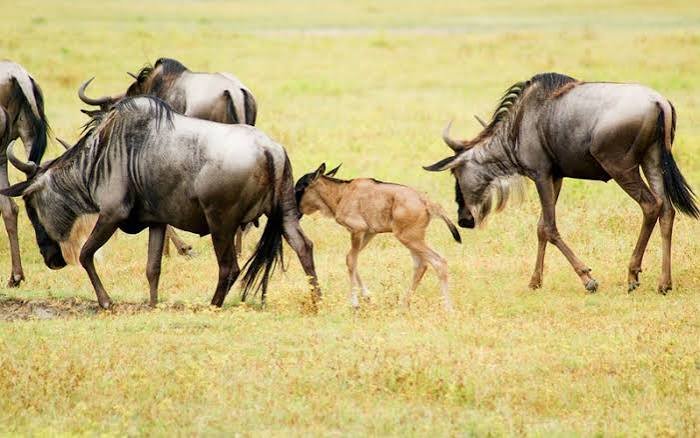
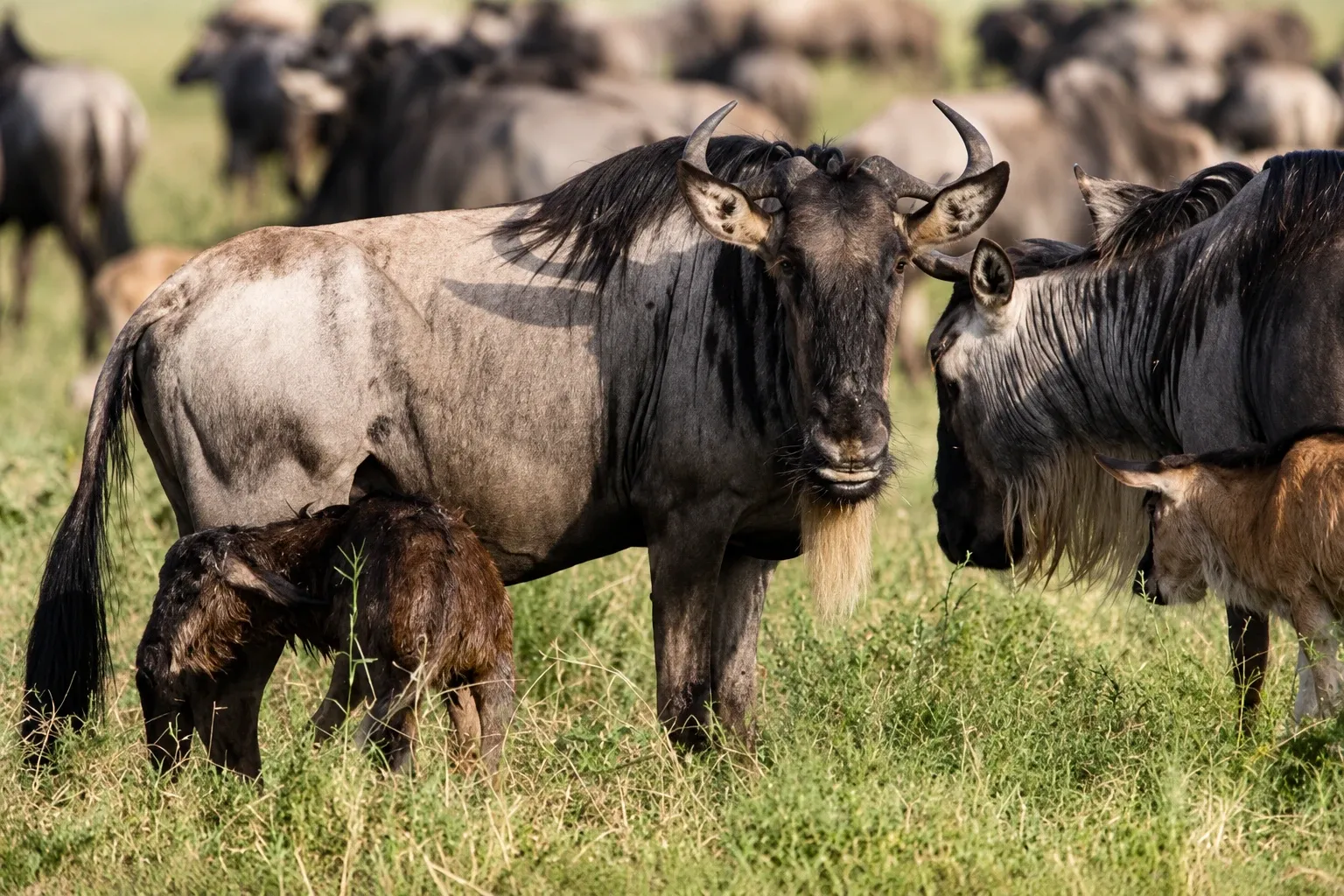
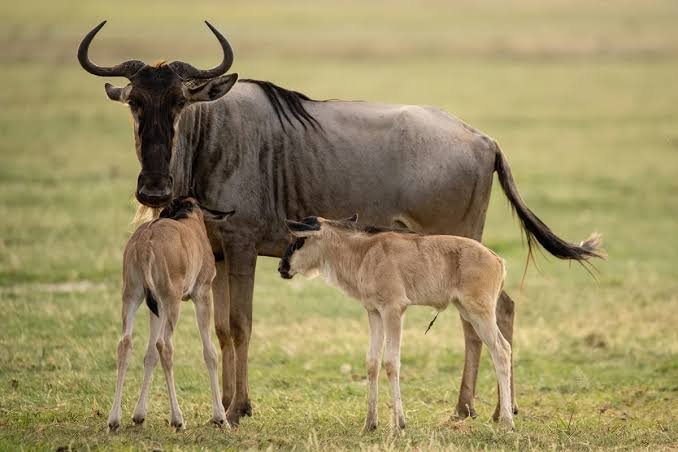
The Southern Serengeti calving season brings large concentrations of wildebeest, zebras and gazelles onto the short-grass plains from approximately December to March. February is generally the main calving period. The abundance of newborn animals attracts lions, cheetahs, spotted hyenas, jackals and other predators, but kills are never guaranteed. Wildlife distribution changes with rainfall, water and fresh grazing.
What Wildlife Can You See During the Southern Serengeti Calving Season?
Wildebeest dominate the Southern Serengeti during the calving season, but the experience involves a much broader ecosystem.
The principal wildlife includes:
- Blue wildebeest
- Plains zebra
- Thomson’s gazelle
- Grant’s gazelle
- Eland
- Hartebeest
- African buffalo
- Giraffe
- African elephant
- Warthog
- Lion
- Cheetah
- Spotted hyena
- Black-backed jackal
- Golden jackal
- Leopard
- Serval
- Caracal
- Bat-eared fox
- Vultures and other scavenging birds
- Numerous resident and migratory bird species
The exact combination depends on where you travel within Ndutu and the Southern Serengeti. Open plains, alkaline lakes, acacia woodland, marshes and rocky kopjes support different animals.
Where Does the Calving Season Take Place?
The main calving grounds extend across 2 adjoining protected areas:
- The Ndutu plains inside the Ngorongoro Conservation Area
- The Southern Serengeti plains inside Serengeti National Park
Lake Ndutu, Lake Masek and the surrounding short-grass plains form the core of the area commonly called Ndutu. The wildlife moves freely across the administrative boundary between Ngorongoro and Serengeti.
This distinction matters when selecting accommodation, calculating protected-area fees and designing a route. Our guide to Ndutu camps inside vs outside the Ngorongoro Conservation Area explains how camp location affects driving times, wildlife access and safari costs.
Why Do Wildebeest Calve in the Southern Serengeti?
The short-grass plains provide nutritious grazing following seasonal rain. Volcanic soils associated with the wider Ngorongoro highlands support mineral-rich grass that is particularly valuable to female wildebeest while they are giving birth and producing milk.
Several conditions make the area suitable:
- Fresh grass following the seasonal rains
- Wide plains with long-distance visibility
- Temporary pools and seasonal water sources
- Nutrient-rich grazing
- Space for large herds to spread out
- Open terrain where wildebeest can detect approaching predators
The timing and distribution of the herds vary annually because rainfall does not follow an exact schedule.
When Is the Southern Serengeti Calving Season?
The wider southern migration season normally runs from December to March or early April. Calving is most concentrated during a shorter period, usually from late January through February.
| Period | Typical wildlife pattern |
|---|---|
| December | Herds begin arriving on the southern plains after sufficient rain |
| January | Pregnant wildebeest gather across Ndutu and Southern Serengeti |
| February | Main calving period and strong predator activity |
| March | Many calves are stronger and the herds may begin shifting |
| April | Herds commonly start moving west or north as conditions change |
These timings are approximate. The migration follows rain and grazing rather than fixed calendar dates.
How Many Wildebeest Calves Are Born?
Published estimates commonly suggest that several hundred thousand wildebeest calves are born during the wider calving period. Frequently repeated daily figures range into several thousand births during the most concentrated weeks.
These numbers should be treated as ecosystem-level estimates, not as a count that a traveller will personally witness. The herds spread across an enormous area, and only a small proportion of births take place within sight of safari vehicles.
What travellers are more likely to observe includes:
- Very young calves walking beside their mothers
- Groups of calves resting together
- Females searching for their calves
- Calves running with moving herds
- Nursing behaviour
- Herds reacting to nearby predators
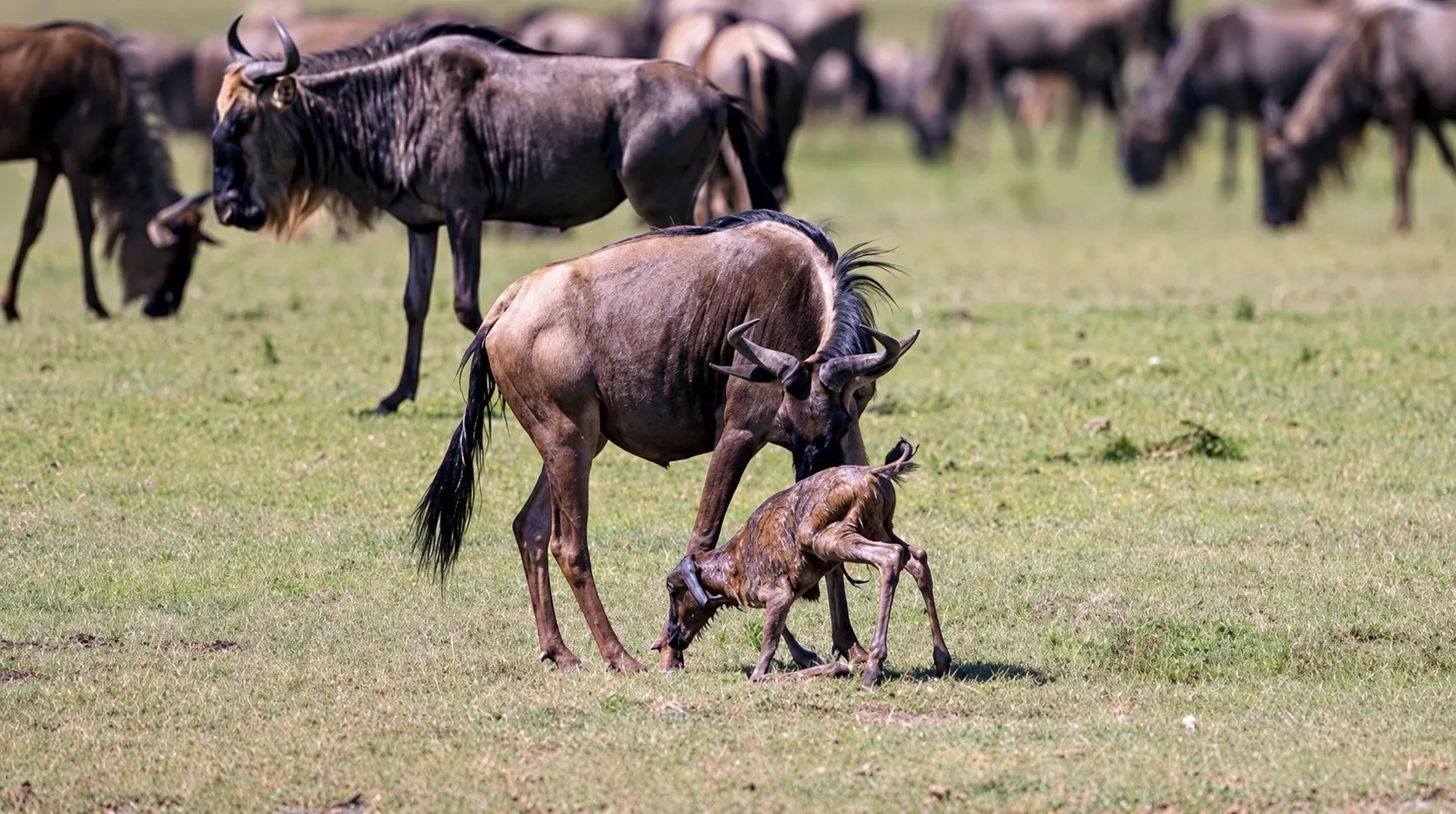
Watching an actual birth is possible but uncommon and cannot be guaranteed.
Why Are Wildebeest Births So Closely Timed?
Wildebeest calving is highly synchronized, with many females giving birth within a relatively short period.
This concentration offers an important survival advantage. Predators and scavengers can consume only a limited number of animals at a time. When many calves are born within several weeks, the majority have an opportunity to survive and strengthen.
The strategy does not protect every individual calf. It improves survival across the population by producing more young animals than predators can take during the concentrated birth period.
Which Predators Can You See in the Southern Serengeti?
The Southern Serengeti supports several large and small predators. Some follow or concentrate around the migratory herds, while others maintain territories in woodland, kopjes or grassland habitats.
| Predator | Relative likelihood | Habitat and behaviour |
|---|---|---|
| Lion | Common in suitable areas | Plains, woodland edges and kopjes |
| Cheetah | Frequently observed on open plains | Uses visibility and speed to hunt |
| Spotted hyena | Common but sometimes underestimated | Hunts and scavenges across the plains |
| Black-backed jackal | Frequently observed | Hunts small prey and scavenges |
| Golden jackal | Possible | Open plains and woodland edges |
| Leopard | Possible but less predictable | Woodland, drainage lines and trees |
| Serval | Occasional | Taller grass and wetland margins |
| Caracal | Uncommon | Grassland and scrub |
| African wild dog | Rare and unpredictable | Wide-ranging; not a reliable Ndutu sighting |
No predator sighting or hunting event can be guaranteed.
Lions During the Calving Season
Lions are among the most visible large predators in the Southern Serengeti ecosystem. Prides occupy territories that may include open plains, woodland margins, drainage lines and rocky kopjes.
During the calving season, lions may hunt:
- Wildebeest
- Zebras
- Gazelles
- Warthogs
- Buffalo calves
- Other available prey
Lions do not focus exclusively on newborn wildebeest. They select opportunities according to the size and composition of the pride, prey vulnerability and local conditions.
Where are lions commonly found?
Guides often search for lions around:
- Rocky kopjes
- Woodland edges
- Shaded areas during the middle of the day
- Water sources
- Areas where large herds have gathered
- Slight rises overlooking open plains
Lions are often most active during cooler periods. Early morning can reveal animals still moving or feeding after nighttime activity, while afternoon sightings may involve resting prides.
Cheetahs on the Ndutu Plains
The open terrain of Ndutu and the Southern Serengeti provides suitable cheetah habitat. Short grass allows cheetahs to watch prey from a distance while also giving gazelles and wildebeest a chance to detect approaching predators.
Cheetahs in the area may hunt:
- Thomson’s gazelles
- Young wildebeest
- Young impalas where habitat allows
- Hares
- Other small or medium-sized prey
Female cheetahs with cubs require regular hunting success, but sightings involving cubs should be treated carefully. Guides must avoid crowding, blocking movement or revealing a cheetah’s position to other predators.
Is a cheetah chase guaranteed?
No. Travellers may see cheetahs resting, scanning from a termite mound, walking between hunting areas or feeding. An active chase is possible but represents only a small part of the animal’s day.
Patience and a private game-drive schedule improve observation opportunities without guaranteeing a hunt.
Spotted Hyenas: Hunters as Well as Scavengers
Spotted hyenas are sometimes described only as scavengers, but they are effective hunters with complex social systems.
During the calving season, they may:
- Hunt wildebeest calves
- Pursue weakened adults
- Search for unattended young animals
- Feed on existing carcasses
- Compete with lions, cheetahs and jackals
- Travel considerable distances in search of food
Hyenas can be active throughout the day, but early morning often provides good opportunities to see them returning from nighttime activity.
A group of hyenas is called a clan. Clan members communicate using calls, scent and body posture.
Leopards in the Southern Serengeti
Leopards occur in the wider ecosystem but are generally less predictable on the open calving plains than lions, cheetahs and spotted hyenas.
They are more likely to use:
- Acacia woodland
- Riverine vegetation
- Drainage lines
- Rocky kopjes
- Areas with sufficient cover
Leopards are solitary and secretive. Their spotted coats make them difficult to detect in branches, shade and dense vegetation.
Travellers should not choose a Southern Serengeti safari expecting a guaranteed leopard sighting. Central Serengeti’s river valleys and woodland habitats are often added to an itinerary to broaden the opportunity to see leopards and other resident wildlife.
Jackals, Servals and Smaller Predators
The calving season is also an opportunity to observe smaller carnivores that receive less attention than the big cats.
Black-backed jackals
Black-backed jackals may be seen alone, in pairs or around carcasses. They hunt small mammals, birds and insects and also take advantage of food left by larger predators.
Golden jackals
Golden jackals also occur on the plains, although distinguishing similar canids at a distance can be difficult. A knowledgeable guide can help identify species through body size, colouring and behaviour.
Servals
Servals use their long legs and hearing to locate rodents in grass. They are most frequently associated with areas that provide slightly taller vegetation or wetter ground.
Caracals
Caracals are present but uncommon and difficult to locate. A caracal sighting should be considered fortunate rather than expected.
Bat-eared foxes
Bat-eared foxes feed heavily on insects, especially termites, although they may also take small vertebrates. Families can sometimes be observed foraging across open ground.
Zebras and Their Role in the Migration
Zebras travel alongside wildebeest because the 2 species can use the same grasslands in complementary ways.
Zebras can feed on taller, tougher grass. Wildebeest then graze shorter regrowth. Their combined presence also increases the number of animals watching and listening for predators.
During the calving season, travellers may observe:
- Mares with young foals
- Stallions defending family groups
- Zebras grooming one another
- Herds mixing with wildebeest
- Alarm reactions when predators approach
Zebra births are not synchronized as tightly as wildebeest calving, but young foals are regularly seen during the southern season.
Gazelles and Other Grazing Animals
Thomson’s and Grant’s gazelles are important residents of the open plains.
Thomson’s gazelle
Thomson’s gazelles are smaller and may gather in large groups. They are an important prey species for cheetahs.
Grant’s gazelle
Grant’s gazelles are larger and generally more tolerant of dry conditions. They can survive longer without directly drinking because they obtain moisture from vegetation.
Eland
Eland are the largest antelope species and can occur in herds across the plains. Despite their size, they can be cautious and may move away as vehicles approach.
Hartebeest
Hartebeest are less numerous than wildebeest but may be observed in open grassland.
Buffalo
African buffalo are more likely around areas with dependable grass and water. They do not form part of the Great Migration but are resident within the ecosystem.
Elephants and Giraffes in Ndutu
Elephants and giraffes are more strongly associated with woodland than with the treeless short-grass plains.
Around Lake Ndutu, Lake Masek and the acacia-covered areas, travellers may encounter:
- Family groups of elephants
- Solitary bull elephants
- Giraffes feeding on acacia trees
- Mothers with young calves
- Animals moving between woodland and water sources
Their presence varies with water, vegetation and seasonal movement. They may be absent from the most open sections of the plains while remaining visible around woodland habitats.
Birds During the Calving Season
The wet-season landscape supports both resident and migratory birds. Birdwatching can be excellent even when the mammal herds are widely dispersed.
Species and groups that may be encountered include:
- Secretary birds
- Kori bustards
- Crowned cranes
- Ostriches
- Vultures
- Martial eagles
- Tawny eagles
- Steppe eagles
- Bateleurs
- Southern ground hornbills
- Storks
- Lapwings
- Larks
- Fischer’s lovebirds
- Flamingos when lake conditions are suitable
The presence of flamingos at Lake Ndutu or Lake Masek depends on water level, salinity and food conditions. They should not be treated as guaranteed sightings.
Why are vultures important?
Vultures remove carcasses rapidly and reduce the spread of disease. Different vulture species feed on different parts of a carcass, allowing several species to use the same food source.
A concentration of vultures in the air or on the ground may help a guide locate a carcass, but visitors should not assume that every circling bird indicates a fresh kill.
What Predator Behaviour Might You Witness?
Possible predator behaviour includes:
- Lions watching herds from cover
- Cheetahs scanning from termite mounds
- Hyenas travelling or hunting
- Jackals waiting near larger predators
- Territorial marking
- Adults caring for cubs
- Feeding at a carcass
- Competition between predator species
- Unsuccessful hunts
- Long periods of resting
Most predators spend substantial time conserving energy. A realistic safari includes patient observation, not continuous hunting action.
An unsuccessful chase can be as informative as a successful hunt because it demonstrates prey awareness, predator strategy and the energy costs of hunting.
Can You Watch a Wildebeest Birth or Predator Hunt?
It is possible, but neither can be promised.
The Southern Serengeti covers a large area, and wildlife events unfold without schedules. A guide can position the safari in a productive area, interpret animal behaviour and wait patiently, but cannot control what happens.
Be cautious of any itinerary that promises:
- A live wildebeest birth
- A predator kill
- A cheetah chase
- A specific number of big-cat sightings
- A particular herd location
- Wildlife immediately outside the camp
A well-designed safari improves opportunities; it does not guarantee individual natural events.
Which Month Is Best for Wildlife and Predators?
| Month | Calves | Predators | Landscape | Main consideration |
|---|---|---|---|---|
| December | Few newborns initially | Resident predators | Becoming green after rain | Herd arrival varies |
| January | Increasing numbers | Strong activity | Green plains | Good balance of scenery and wildlife |
| February | Main calving period | Usually excellent opportunities | Green to gradually drying | Highest accommodation demand |
| March | Older, more mobile calves | Still rewarding | Variable rainfall | Herds may begin moving |
| April | Calving largely finished | Wildlife more dispersed | Long-rain conditions possible | Some seasonal camps close |
For travellers specifically interested in newborn wildebeest and predator interactions, February is generally the strongest month. Late January and early March can also be rewarding and may suit travellers who want slightly different conditions.
Does Rain Affect Wildlife Viewing?
Yes. Rain determines the availability of fresh grazing and water, which influences where the herds gather.
After useful rainfall
- Grass becomes green and nutritious
- Wildebeest may spread across a large area
- Temporary water sources become available
- The landscape becomes more attractive for photography
- Some roads may become muddy
During a dry period
- Herds may concentrate near remaining grazing and water
- Dust can increase
- Wildlife may move sooner than expected
- Driving conditions may be easier on some tracks
Rain normally falls in showers rather than continuously throughout every day, but weather cannot be predicted precisely months in advance.
What Is a Typical Calving-Season Game Drive Like?
A private game drive may begin early in the morning when temperatures are cooler and predators are more active.
The guide will consider:
- Recent herd reports
- Predator locations from previous drives
- Weather
- Road conditions
- Information shared by other professional guides
- The interests of the travellers
- Applicable conservation regulations
Travellers can choose between:
Full-day game drive
A full-day drive allows the guide to search farther across the plains without returning to camp for lunch. A picnic lunch is normally carried.
Morning and afternoon game drives
Split drives allow travellers to return to camp during the warmest part of the day. This arrangement can suit families and guests who prefer a slower pace.
A private safari provides greater flexibility because the daily schedule does not need to be shared with unrelated travellers.
How Many Days Do You Need?
A minimum of 3 nights in Ndutu or Southern Serengeti is recommended. This provides 2 full days for game drives.
| Length of stay | Wildlife opportunity |
|---|---|
| 2 nights | Limited; suitable for a short itinerary |
| 3 nights | Recommended minimum |
| 4 nights | Strong choice for wildlife enthusiasts and photographers |
| 5 nights or more | Suitable for specialist observation and slower travel |
Longer stays matter because wildlife conditions change from day to day. A quiet morning can be followed by significant movement or predator activity later that day or in another part of the plains.
Is Ndutu or Central Serengeti Better for Predators?
Both areas support predators, but they offer different environments.
| Feature | Ndutu and Southern Serengeti | Central Serengeti |
|---|---|---|
| Main seasonal attraction | Wildebeest calving | Resident wildlife throughout the year |
| Landscape | Short-grass plains and woodland | Rivers, woodland, plains and kopjes |
| Cheetah habitat | Particularly suitable open terrain | Present in suitable areas |
| Lions | Strong opportunities | Strong year-round opportunities |
| Leopards | Possible but less predictable | Often associated with river valleys and trees |
| Best months | December–March | Year-round |
| Recommended combination | 3–4 nights | 2–3 nights |
For a 6–8-day safari, combining both regions provides greater habitat diversity and broader wildlife opportunities.
Choosing a Camp for Wildlife Access
The best camp is not necessarily the most luxurious. Location, travel dates and access to current wildlife areas matter more.
When comparing camps, ask:
- Is it inside the Ngorongoro Conservation Area or Serengeti National Park?
- How far is it from Lake Ndutu and Lake Masek?
- Where will the camp be positioned on my dates?
- Does it offer private game drives?
- Can it prepare early breakfast or packed meals?
- Are family rooms available?
- Can batteries and cameras be charged?
- Is the camp seasonal or permanent?
- How does its location fit the next destination?
Read our comparison of the best camps and lodges in Ndutu for the calving season before choosing accommodation.
Calving-Season Photography Advice
The Southern Serengeti’s open landscape is well suited to wildlife photography, but good results require patience.
Practical recommendations include:
- Use a private vehicle where possible
- Request a guaranteed window position
- Carry a telephoto lens for distant behaviour
- Keep a second camera or wider lens ready for herds and landscapes
- Bring spare batteries and memory cards
- Use a dust cover or protective bag
- Avoid changing lenses in dusty conditions
- Ask the guide to position the vehicle without disturbing wildlife
- Allow time for animals to become comfortable with the vehicle
- Photograph behaviour, habitat and herd patterns—not only close portraits
Morning and late-afternoon light generally provide softer colours and fewer harsh shadows.
Responsible Predator Viewing
Predator sightings can quickly attract numerous vehicles. Responsible viewing protects wildlife and produces a better safari experience.
A good guide should:
- Maintain an appropriate distance
- Avoid blocking an animal’s route
- Never separate a mother from her young
- Avoid surrounding a predator
- Keep noise low
- Follow authorized tracks and current regulations
- Leave an overcrowded sighting when necessary
- Give hunting animals space
- Avoid directing other vehicles to sensitive cub locations
- Follow instructions from conservation authorities
Travellers should never pressure a guide to drive too close or ignore regulations for a photograph.
Who Will Enjoy a Calving-Season Safari?
This safari is particularly suitable for:
- Travellers interested in animal behaviour
- Wildlife photographers
- Visitors who prefer open plains to river crossings
- Families with children interested in nature
- Repeat safari travellers
- Big-cat enthusiasts
- Birdwatchers
- Travellers combining Ndutu with Ngorongoro or Central Serengeti
It may be less suitable for travellers who:
- Are uncomfortable seeing predation
- Expect constant dramatic action
- Want guaranteed wildlife events
- Dislike rain, mud or changing road conditions
- Prefer conventional hotels to remote safari camps
- Have only 1 night available in the area
Parents should explain the natural predator-and-prey cycle to children before the safari.
Common Calving-Season Planning Mistakes
Expecting the migration to follow exact dates
Rain determines wildlife movement. February is generally the main calving month, but herd location varies.
Booking accommodation too far from the plains
A lower room price may result in long daily transfers and less wildlife-viewing time.
Staying for only 1 night
A short visit provides little flexibility if the herds are distant or the first game drive is quiet.
Assuming every calf is newly born
Some calves seen in February may already be several weeks old. This is part of the natural progression of the season.
Expecting continuous predator action
Lions, cheetahs and hyenas spend considerable time resting, walking or observing prey.
Focusing only on a kill
Social behaviour, communication, hunting preparation, unsuccessful chases and interactions between species can be equally valuable.
Choosing a shared vehicle for a specialist interest
Shared drives may not allow photographers or predator enthusiasts to remain at a sighting as long as they want.
KiliPori Expert Recommendation
For travellers whose priority is Southern Serengeti calving season wildlife and predators, KiliPori Safaris recommends 3–4 nights in the wider Ndutu area, with a private vehicle and flexible game-drive schedule.
February normally provides the strongest opportunity to see large numbers of calves, but late January and early March can also be rewarding. Choose accommodation according to its exact seasonal location rather than its luxury rating alone.
A strong 6–7-day route can include:
- Arrival in Arusha
- Transfer or flight to Ndutu
- 3–4 nights in Ndutu or Southern Serengeti
- 2 nights in Central Serengeti
- Fly back to Arusha, Kilimanjaro or Zanzibar
Combining Ndutu with Central Serengeti adds riverine and woodland habitats, improving the overall variety of wildlife without relying entirely on the migration’s location.
Frequently Asked Questions
What animals are seen during the Southern Serengeti calving season?
The principal animals are wildebeest, zebras, Thomson’s gazelles and Grant’s gazelles. Lions, cheetahs, spotted hyenas and jackals are important predators. Travellers may also see elephants, giraffes, eland, buffalo, servals, bat-eared foxes and numerous birds.
When is the main wildebeest calving period?
The main calving period generally occurs from late January through February. The wider Southern Serengeti migration season extends from approximately December to March, depending on rainfall.
Is February the best month for predators?
February is usually one of the strongest months because large herds and newborn calves attract predator activity. However, a hunt or kill cannot be guaranteed on any particular day.
Where is the best place to see cheetahs?
The open plains around Ndutu and the southeastern Serengeti provide suitable cheetah habitat. Their exact locations change, so an experienced guide and adequate time in the area are important.
Are lions common in Ndutu?
Lions are regularly observed in suitable territories around the plains, woodland edges and kopjes. Their visibility varies according to temperature, prey movement and pride location.
Can children watch the calving season?
Yes, the calving season can be educational for children, but parents should prepare them for possible predator hunts, carcasses and other natural events. A private vehicle allows greater control over the schedule.
Will I see a wildebeest giving birth?
It is possible but not guaranteed. Births occur across an extensive area, and many happen away from roads or safari vehicles.
Are predator kills distressing to watch?
Some travellers find predation difficult. Tell your guide if you prefer not to watch. The vehicle can leave the sighting and concentrate on other wildlife.
How many nights should I spend in Ndutu?
Three nights are the recommended minimum, while 4 nights are better for photographers and travellers primarily interested in calving-season wildlife.
Does rain stop game drives?
Light or intermittent rain does not normally stop a game drive. Heavy rain may affect particular tracks, and guides may adjust the route according to road conditions and conservation rules.
Plan Your Trip With KiliPori Safaris
KiliPori Safaris designs private Southern Serengeti and Ndutu calving-season safaris based on travel dates, wildlife interests, group size and preferred accommodation level.
Your itinerary can include:
- A private 4×4 Land Cruiser
- A professional Tanzania driver-guide
- 3–4 nights in Ndutu or Southern Serengeti
- Ngorongoro Crater
- Central Serengeti
- Domestic flights where practical
- Family-friendly or photography-focused arrangements
- A Zanzibar extension
To request a personalized itinerary or accurate quotation, share your dates, number of travellers, children’s ages, preferred comfort level and whether wildlife photography or predator behaviour is a priority.
WhatsApp: +255 755 287 311
Final Recommendation
The Southern Serengeti calving season wildlife experience is about more than newborn wildebeest. It brings together large grazing herds, vulnerable calves, territorial predators, scavengers, birds and changing weather across one connected ecosystem.
February is generally the strongest month for concentrated calving, while January and March can also provide excellent wildlife viewing. Stay for at least 3 nights, use a camp close to the current herd location and choose a private guide who can adjust daily plans according to rainfall, road conditions and wildlife reports.
Approach predator sightings with realistic expectations. No birth, hunt or kill can be guaranteed, but patient and responsible observation can reveal a wide range of natural behaviour.
Sources and Fact-Checking
- Ngorongoro Conservation Area Authority – Ndutu Plains
- Tanzania National Parks Authority
- UNESCO – Serengeti National Park
- UNESCO – Ngorongoro Conservation Area
- Serengeti Cheetah Project
- Asilia Africa – Great Migration Calving Season
- Seasonal wildlife distribution, road access and protected-area regulations should be reconfirmed for the traveller’s dates.

KiliPori Safaris Travel Team
A local Tanzania team helping travellers plan wildlife safaris, Kilimanjaro climbs and Zanzibar holidays with clear routing and direct destination support.
Published September 17, 2026. Travel conditions, fees and schedules can change; confirm time-sensitive details before departure.